
The UAE has consistently led in adopting futuristic technology, and additive manufacturing is no exception. This is our annually-refreshed overview of where the market stands — the policy backbone, the demand shift, the trends worth watching, and what it all means whether you're a founder printing a first prototype or an enterprise rethinking a supply chain. Updated for 2026; the URL never changes, so bookmarks and links stay valid year to year.
The Policy Backbone: Dubai 3D Printing Strategy
The market didn't grow by accident. The Dubai 3D Printing Strategy, launched in 2016, set the vision to make the emirate a global additive-manufacturing hub, with a headline goal that 25% of all new Dubai buildings be constructed using 3D printing by 2030. Around it sits real infrastructure: R&D investment through UAE universities and tech hubs, regulatory advancement (including Dubai Municipality licensing for printed construction under Decree No. 24 of 2021 and, since 2023, the world's first conformity mark for construction printing), and incentives that pull startups and enterprises toward adoption. The strategy also aligns with the broader Vision 2030 and UAE Net Zero 2050 agendas — efficiency and sustainability, not novelty.
The Defining Shift: From Prototypes to Production
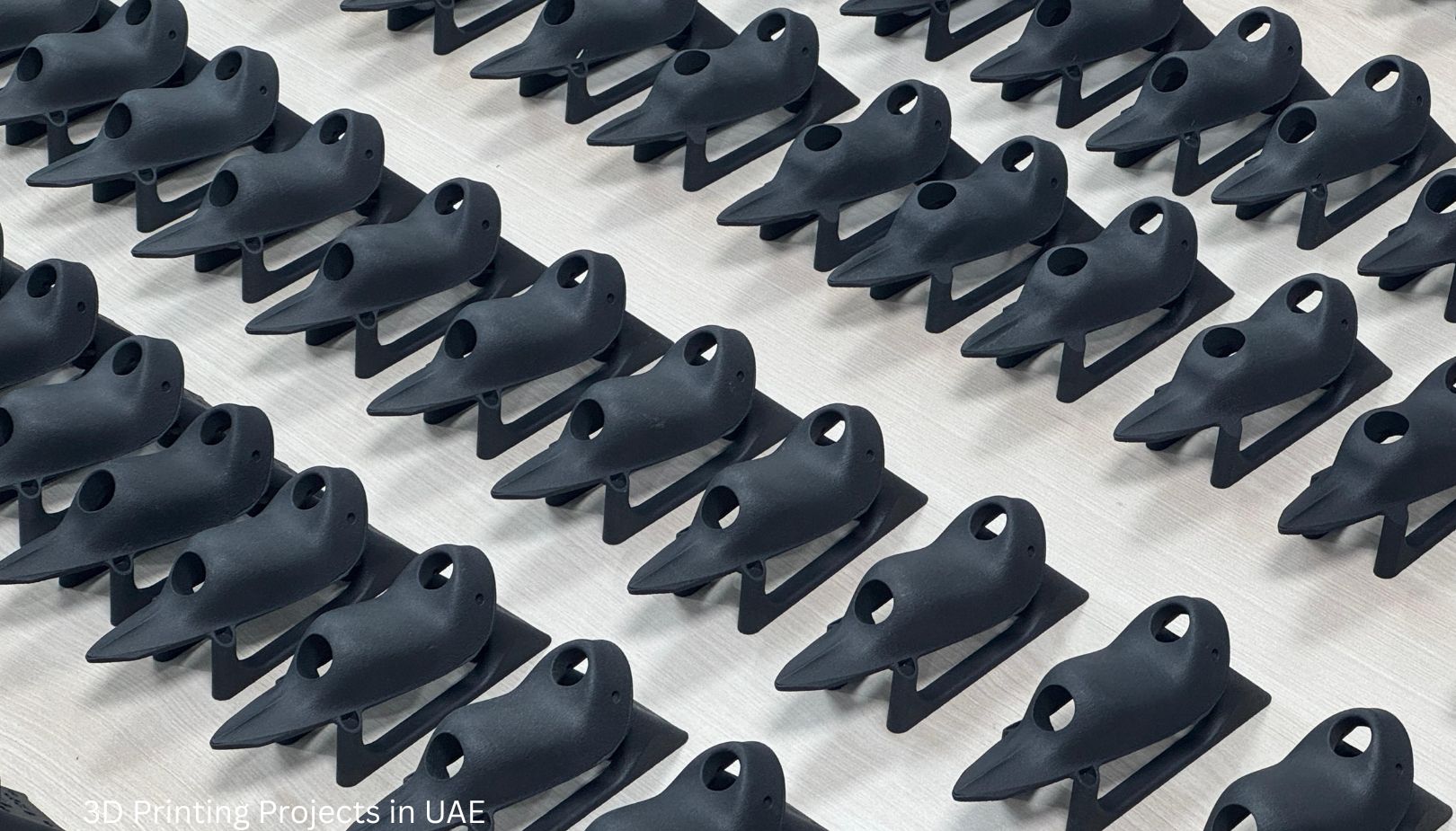
If there is one change that defines the current era, it's this: 3D printing in the UAE stopped being just a design aid and became a manufacturing method. In the early years the technology mostly produced concept models to visualise designs. Now companies invest in functional prototypes and end-use components installed directly in machinery, vehicles and products.
We see it in our own order book — a roughly 200% increase in requests for industrial-grade parts over concept models. The driver is trust: businesses now rely on additive for production-level consistency, not just creative freedom, with aerospace, automotive and healthcare leading the charge. Powder-bed nylon (MJF) sits at the centre of that shift; our own production runs on an HP Jet Fusion 4200. The deeper analysis is in the most in-demand technology in the UAE.
Seven Trends Shaping the Market
- 1. Healthcare adoption at the front. Personalised prosthetics, 3D-printed surgical and dental models, orthopaedic planning — hospitals cut cost and improve care, with active programmes at bodies like the Dubai Health Authority.
- 2. Construction scaling up. From the 2016 Office of the Future toward the 2030 target — affordable housing, sustainable infrastructure and futuristic architecture.
- 3. Industrial applications expanding. Aerospace, automotive and oil & gas printing lightweight, durable, custom components to shorten supply chains and lead times.
- 4. Bioprinting research. Tissue scaffolds and regenerative-medicine research position the UAE at the frontier — still lab-stage, but strategically funded.
- 5. AI integration. AI optimises print patterns, predicts failures and drives generative design — most consequential in high-stakes aerospace and healthcare work. (More in AI & generative design.)
- 6. Sustainability focus. Recyclable materials, biodegradable polymers and waste reduction aligned with UAE Net Zero 2050 — additive's material efficiency is a genuine driver, not a talking point.
- 7. On-demand manufacturing. Print spares as needed instead of stockpiling — cutting inventory cost and response time across logistics, aerospace and automotive.
How Startups Leverage It
For startups, additive manufacturing directly attacks the classic constraints — high production cost, limited resources, long development cycles:
- Affordable prototyping — no expensive molds or tooling; iterate at a fraction of traditional cost.
- Faster time-to-market — design, test and refine in days rather than months.
- On-demand production — make parts as needed, no inventory, less waste.
- Customisation — tailor products per customer, a decisive edge in fashion, electronics and healthcare.
One Dubai startup we worked with produced customised drone components this way, cutting production time by around 70% versus their previous route. The pattern repeats across the founder ecosystem.
How Enterprises Leverage It
Larger organisations use additive to improve efficiency, cut cost and de-risk supply:
- Scalability & on-demand parts — manufacture without committing to mass-production runs.
- Lower cost — savings across materials, labour and logistics.
- Sustainability — minimal material waste as an environmental and cost win at once.
- AI-driven accuracy — integrated, automated production reduces error rates.
The most-cited enterprise example is aviation: lightweight printed aircraft parts that reduce fuel consumption. The full UAE capability picture covers how this scales across emirates.
The Honest Challenges
A credible state-of-the-market has to name the friction. Technological limits remain — material strength ceilings and printer-size constraints mean additive doesn't replace every process (and we'll say so; see 3D printing vs CNC and vs injection moulding). Regulation is still maturing, especially quality and safety standards for healthcare and construction. And investment in equipment is significant — which is precisely why on-demand service models exist: access industrial capability without the capital. These are solvable frictions, and the UAE's proactive stance on all three is part of why the market keeps compounding.
Where This Goes Next
Expect deeper AI-and-additive convergence, decentralised on-demand manufacturing that shortens global supply chains, continued bioprinting research, and steady expansion into aerospace and defence. New jobs in design, engineering and production follow, supported by the UAE's education and training investment.
The throughline is consistent: 3D printing in the UAE is no longer a futuristic idea — it's a present-day manufacturing reality, transforming industries one layer at a time. We'll update this page again next year. In the meantime, the practical starting points are our services, a cost guide, or simply a conversation about your project.