FDM 3D Printing. The workhorse of additive manufacturing.
Fused Deposition Modeling is the most widely used 3D printing technology — known for its precision, affordability and versatility. Here's how it works, what it's best at, and when we'd honestly steer you to something else.
Melt. Extrude. Layer. Repeat.
A heated nozzle melts thermoplastic filament and deposits it layer by layer until a solid part emerges.
Design & Slicing
Your 3D model is converted into machine instructions — layer paths, speeds and temperatures — using slicing software.
Extrusion & Layering
The heated nozzle melts filament and deposits it precisely, layer by layer, onto the build platform.
Cooling & Bonding
Each layer fuses to the one below as it cools, building up the final solid structure.
What FDM Is Great At — and Where It Isn't
Advantages
- The most affordable technology — low material and machine costs
- Diverse material selection: PLA, ABS, PETG, TPU, composites
- Larger build volumes than resin alternatives — and segmentable beyond
- Durable, functional prototypes you can actually test
- Fast turnaround — our farm prints many parts in parallel
Trade-Offs
- Visible layer lines — surfaces need finishing for display quality
- Less fine detail than SLA resin for miniature features
- Some materials can warp on large flat parts — we design around it
- Support structures leave marks on overhangs
- Complex geometries print slower than powder-bed systems
Need finer detail or stronger nylon? Compare FDM vs SLA — or just tell us the job and we'll pick for you.
Thermoplastics for Every Job
PLA
Cost-effective and eco-friendly — the default for prototypes and models.
ABS
Tough and heat-tolerant for functional, high-strength parts.
PETG
Strong, slightly flexible and moisture-resistant — a great all-rounder.
TPU (Flexible)
Rubber-like elasticity for grips, seals, wearables and dampers.
Carbon-Fiber Composites
Reinforced filaments for stiff, lightweight engineering parts.
ASA (Outdoor)
UV- and heat-stable — the right choice for the UAE climate outdoors.
FDM Engineering Specifications at Orbit3D
| Layer heights | 0.1 mm (fine) · 0.2 mm (standard) · 0.3 mm (draft/speed) |
|---|---|
| Dimensional tolerance | ±0.2 mm typical — verified before dispatch |
| Build volume | 256 × 256 × 256 mm per printer (Bambu Lab fleet); larger parts via segmented builds |
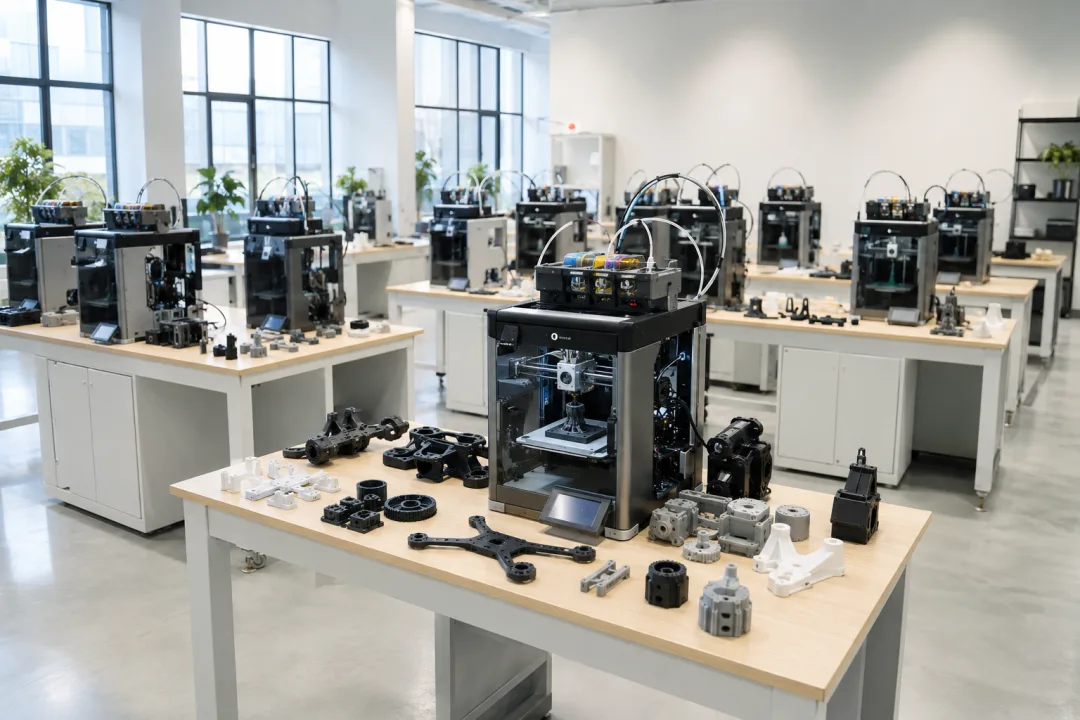
| Fleet capacity | 100+ enclosed, temperature-controlled printers running in parallel |
| Materials | PLA · ABS · PETG · TPU · ASA · PC · carbon-filled |
| Typical lead time | Most parts within a few days; express options available |
From First Prototype to Full Print-Farm Batch
Rapid prototyping for product development, medical devices, prosthetics and anatomical models, custom surgical tools, lightweight automotive and aerospace components, jigs and tooling, architectural massing models and large-format builds — FDM covers more ground than any other technology we run.

FDM 3D Printing — Common Questions
Is FDM accurate enough for engineering parts?
Yes for most applications — typical accuracy is ±0.2 mm or ±0.5%, and we verify critical dimensions before dispatch. For very fine features or ultra-smooth surfaces, we'll recommend SLA or MJF instead.
How much does FDM printing cost?
FDM is our most economical technology — per-part pricing depends on size, settings and finish. See the full cost guide, or request a quote for exact pricing.
Can layer lines be removed?
Yes — our painting & post-processing service sands, primes and paints FDM parts to a smooth, display-grade finish.
What's the biggest part you can FDM print?
Single pieces are limited by machine build volume, but segmented large-format builds extend that to multi-metre structures, bonded and finished seamlessly.
FDM, SLA or MJF — how do I choose?
Rule of thumb: FDM for economy and size, SLA for detail and finish, MJF for strong functional nylon. Our comparison guide covers it: FDM vs SLA.
Guides on This Topic
Put the FDM Farm
To Work on Your Parts.
Upload your file for an instant estimate — or ask an engineer whether FDM is genuinely the right technology for your job.