End-Use &
Production Parts.
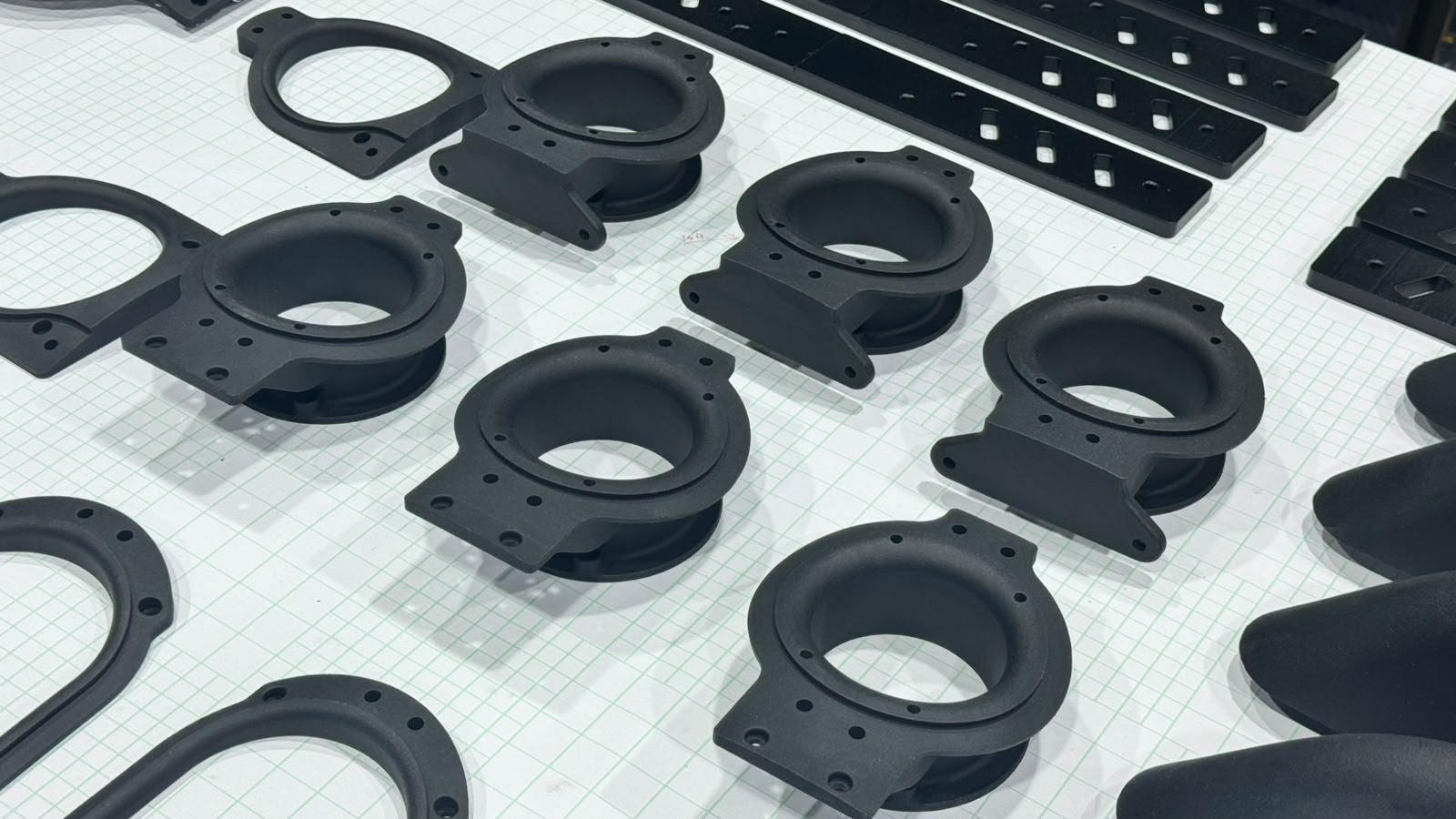
When the part isn't for testing — it's the finished thing you install, ship or sell. Orbit3D produces near-isotropic nylon parts in real quantities on the HP Jet Fusion 4200, with no tooling and flexible batch sizes from the very first run.
Finished Parts, Made to Be Used
A prototype answers "does this work?" A production part is the work — it goes into a product, a machine or a customer's hands. That demands consistency batch to batch, not a lucky first print.
Consumer Product Parts
Housings, enclosures and components that ship inside a finished product.
Functional Machine Parts
Working components installed in equipment — hinges, gears, manifolds, brackets.
Replacement & Spare Parts
On-demand spares — printed when needed instead of warehoused for years.
Short-Run Product Batches
Tens to hundreds of identical units — sellable inventory without a mould.
Why Our End-Use Parts Hold Up
End-use isn't a setting you switch on — it's a material and a process. Our production runs on HP Multi Jet Fusion, which fuses whole layers of nylon PA12 powder at once. The result is near-isotropic strength (consistent in every direction) and part-to-part uniformity that laser processes work harder to match.
No supports means complex geometry prints assembled and clean. And because there's no tooling, changing the design between batches costs nothing but a re-slice.
| Core material | Nylon PA12 (glass-filled available) |
|---|---|
| Process | HP Jet Fusion 4200 (MJF) |
| Strength | Near-isotropic, end-use grade |
| Typical volume | Tens to ~1,000 identical units |
| Tooling cost | None — design changes are free |
| Finish | Natural grey, dyed deep black, or painted |
Other materials — carbon-filled nylon, PC, PETG — quoted where the part's duty calls for them.
Where Additive Production Wins
- Volumes below roughly 1,000 identical units
- Complex geometry that tooling struggles with
- Designs still evolving between batches
- On-demand spares with no inventory to hold
When to Mould Instead
- Above ~1,000 identical units — see 3D printing vs injection moulding
- Metal end-use parts (we run polymers)
- Certified/regulated safety-critical components
The bridge: already scaling past additive's sweet spot? We'll print your parts to keep you selling while your injection-mould tooling is being cut — then hand over at volume. That's honest production planning, not a lock-in.

Prototyped, Fitted, Then Produced as Finished Parts
A dealership modification-kit programme that ran the full arc — test-fit prototypes, refined against the vehicle, then produced and finished in gloss as the final, installable kit. That last step is what "end-use" means: parts that leave here ready to be fitted, not evaluated.
End-Use & Production Parts — Common Questions
Are 3D printed parts really strong enough for end use?
Yes — MJF nylon PA12 is near-isotropic and end-use grade, running in automotive, industrial and consumer products worldwide. We match material to duty and tell you honestly when a part needs a tougher grade like carbon-filled nylon or falls outside polymer territory entirely.
How many parts can you produce?
From a single finished part up to roughly 1,000 identical units economically. Beyond that, injection moulding usually wins on unit cost — and we'll say so, and can bridge-produce while tooling is made.
When does injection moulding become cheaper?
Around 1,000 identical units is the typical crossover. Below it, additive's zero tooling cost wins; above it, moulding's per-unit economics take over. The full comparison shows where your job sits.
Can every unit be slightly different?
Yes — that's a genuine additive advantage. Serial numbers, per-unit customisation and design tweaks between batches cost nothing extra, because there's no fixed mould to change.
Send the Part
and the Quantity.
We'll quote the run, recommend the material, and tell you straight if moulding would serve you better.