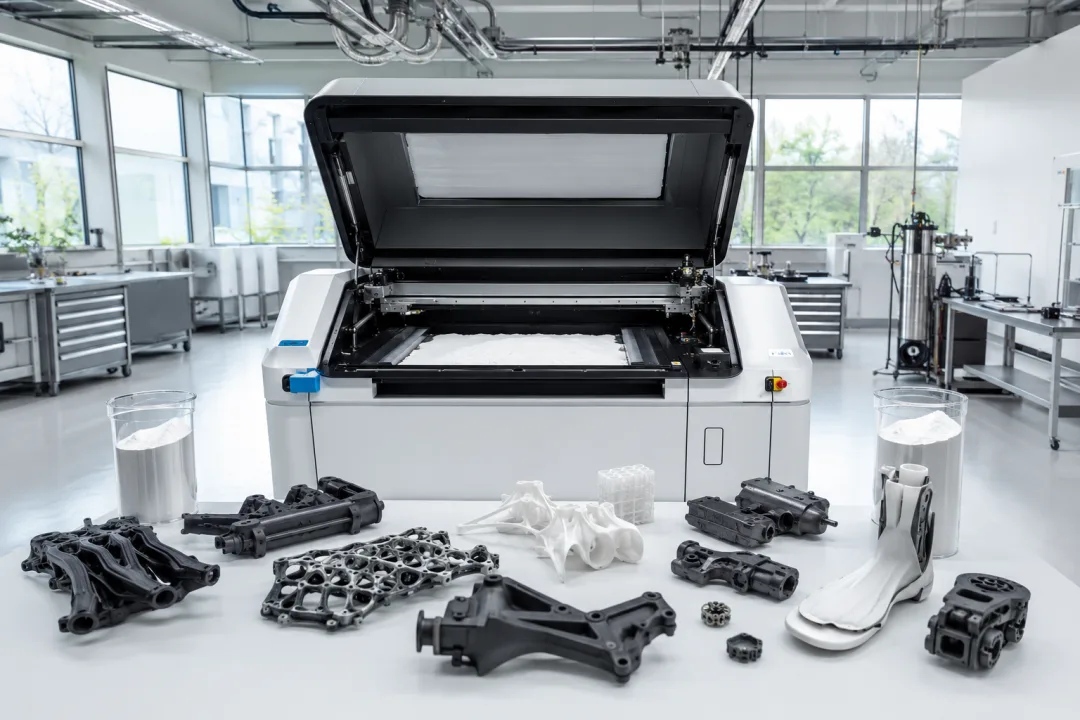
Multi Jet Fusion. Production printing, industrialised.
HP's powder-fusion process builds high-quality, functional nylon parts with exceptional accuracy and strength — melting fine PA12 powder layer by layer into complex geometries and intricate details, at true production batch speeds.
Agents, Heat, and a Bed of Powder
Spread & Jet
Nylon powder spreads; print heads jet fusing and detailing agents exactly where the part exists.
Fuse
Infrared energy melts agent-treated powder — whole layers fuse at once, not point by point.
Cool, Unpack, Finish
Parts emerge from the powder cake, get bead-blasted, and optionally dyed or sealed.
What MJF Is Great At — and Where It Isn't
Advantages
- Production-grade strength with near-isotropic properties
- Whole-layer fusing — the fastest powder-bed batches we run
- Support-free complex geometry — powder holds every overhang
- Exceptional consistency part-to-part and batch-to-batch
- Fine detail and crisp edges from the detailing agent
Trade-Offs
- Grey/black parts natively — dyeing handles colour
- Matte technical surface — polish for cosmetic work
- Nylon-family materials — not a resin-detail rival
- Economics favour batches over single tiny parts
MJF Engineering Specifications at Orbit3D
| Machine | HP Jet Fusion 4200 — in-house at Dubai Investments Park |
|---|---|
| Build volume | 380 × 284 × 380 mm per build — dozens of parts nested per run |
| Material | Nylon PA12 (glass-filled available) |
| Tensile strength | ~48 MPa in XY and Z (ASTM D638) — near-isotropic |
| Dimensional tolerance | ±0.2 mm or ±0.3% typical — inspection reports available |
| Supports | None — powder-supported, so interlocked and internal geometry prints assembled |
| Economics | Best from ~10 identical parts; batches to ~1,000 units without tooling |
The Production Floor's Favourite
End-use functional parts, low-volume production batches, on-demand spares, jigs and fixtures, drone components and housings — everything our low-volume production and additive manufacturing programmes promise gets delivered by this technology.
MJF Printing — Common Questions
Why is MJF our powder-bed technology of choice?
Support-free freedom plus whole-layer fusing — MJF builds fast and exceptionally consistent nylon batches. For most functional nylon work at Orbit3D, MJF is the answer we quote.
Is MJF 3D printing strong?
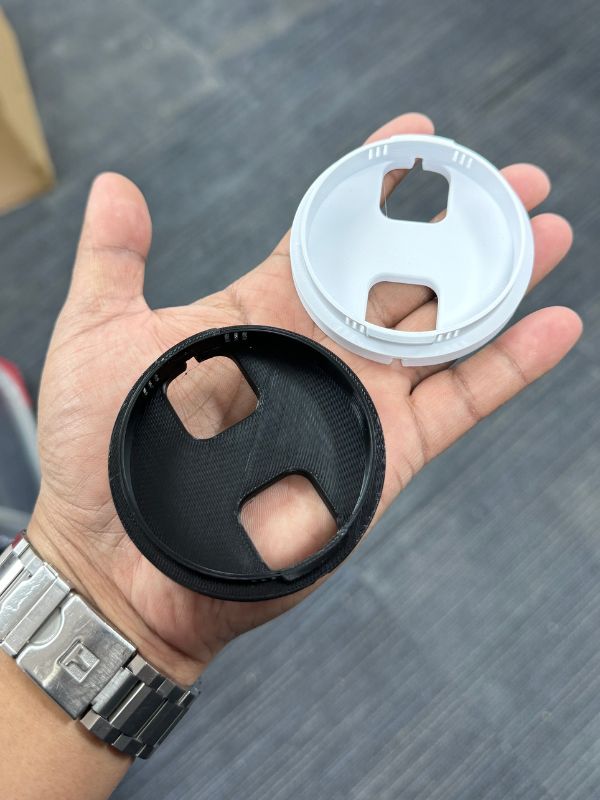
Yes — MJF PA12 reaches a tensile strength of around 48 MPa in both XY and Z directions (ASTM D638), which is what makes it near-isotropic: strength is consistent in every direction of the part’s geometry, unlike layer-dependent FDM. That is production-grade performance, running today in end-use automotive, industrial and consumer applications.
What colours are possible?
Parts print grey and dye beautifully to deep uniform black; other colours via painting. For native colour-critical parts we'll advise honestly.
Is MJF economical for one-off parts?
Singles print fine, but MJF economics shine from ~10 parts up, where the build fills and per-part cost drops sharply — the batch technology by design.
What tolerance can MJF hold?
Typically ±0.2 mm or ±0.3% — with critical dimensions verified before dispatch and inspection reports available for production programmes.
Put Your Production
On the Jet Fusion.
Send the file and target quantity — per-part pricing at your volumes, same day.