
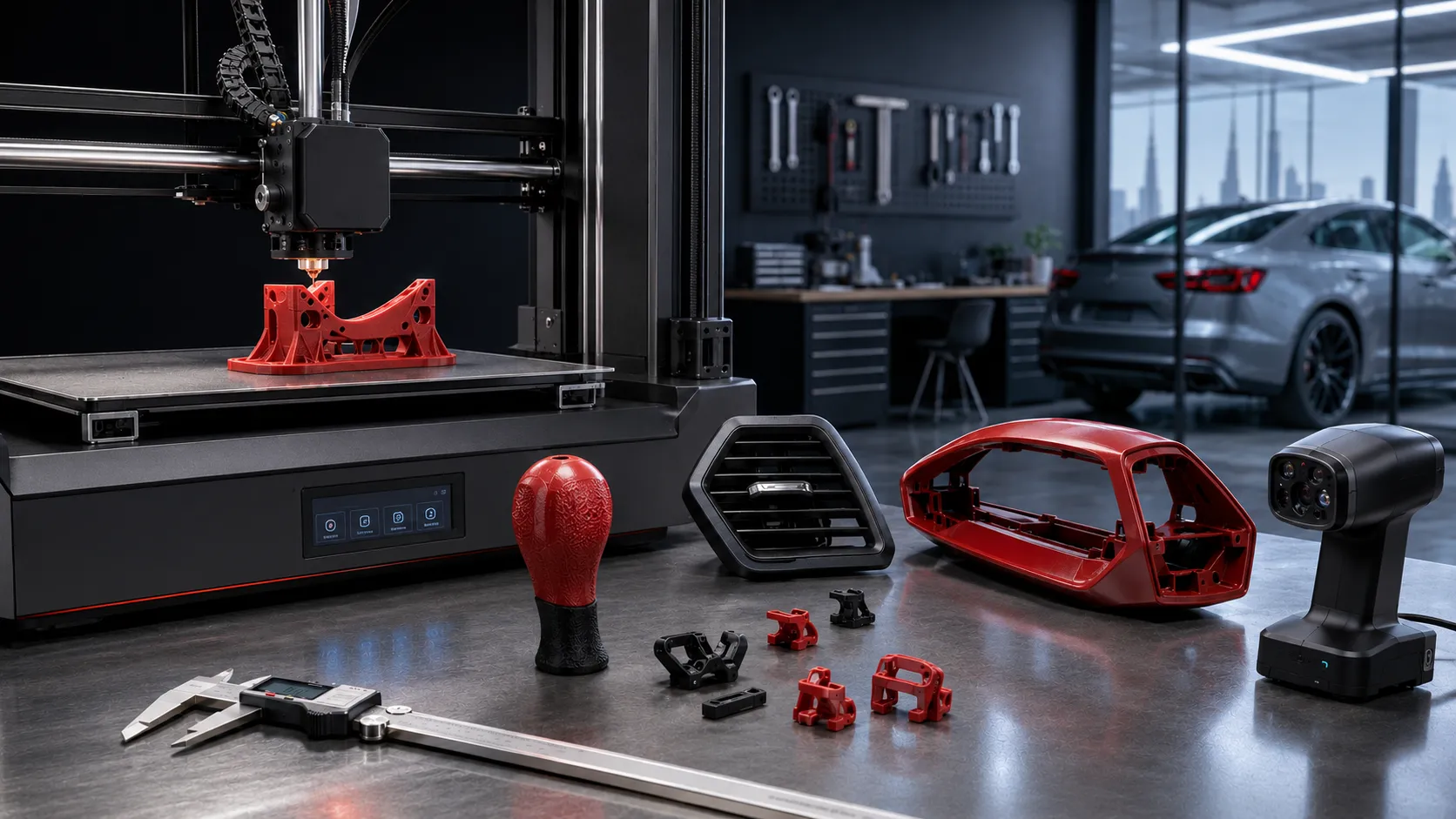
Every week, someone sends a photo to our WhatsApp. A cracked dashboard bracket. A snapped interior clip that the dealer no longer stocks. A knob from a car that went out of production fifteen years ago. The question underneath every one of those photos is the same. Can you 3D print this?
The honest answer is yes, for most parts that do not carry a safety load. And since I opened Orbit3D, the automotive requests landing on our automotive 3D printing desk have grown faster than almost any other category. So I want to give you the full picture in one place. What works, what does not, what it costs, and how the process actually runs from your first message to a part in your hand.
The Short Answer
You can 3D print interior trim, clips, brackets, housings, knobs, air vents, badges, jigs and many under-hood components in the UAE today. You should not 3D print brake components, suspension parts, steering parts or anything inside the engine that carries structural or thermal loads beyond what printed polymers can handle. Any workshop that tells you otherwise is selling you a risk, not a part.
That second sentence matters to me. We turn down safety-critical jobs, and I would rather lose an order than print something that puts a driver at risk. Keep that line in mind through the rest of this guide.
Car Parts We Print Regularly
Interior clips, fasteners and trim retainers — the small plastic pieces that break first and cost the most grief to source.
Dashboard brackets, mounts and switch housings.
Knobs, handles, bezels and button caps.
Air vents, ducting and cable routing guides.
Side mirror internals and housing components.
Cup holders, storage inserts and console organizers.
Badges, emblems and custom interior accents.
Jigs, fixtures and assembly aids for garages and detailing shops.
Prototype panels and fit-check parts for restoration projects.
Notice a theme. These parts fail often, cost little to make, and yet a single missing clip can hold up an entire repair. That mismatch is exactly where 3D printing earns its place.
Parts We Will Not Print, and Why
Brake calipers, rotors and pads. Suspension arms and bushings that carry load. Steering components. Seat belt and airbag hardware. Wheel components. Engine internals.
The materials we print are strong, and I will show you the numbers below. But safety parts go through crash testing, fatigue testing and certification that a printed polymer replacement has not seen. For anything that touches road safety, stick with OEM parts and follow the manufacturer's guidance. We say this to customers every week, and most of them thank us for the straight answer.
From Broken Part to New Part: How It Works
Most customers assume they need a CAD file. You do not. This is the usual path:
Step 1: Send us what you have
A photo on WhatsApp starts most jobs. If you have the broken part, even in pieces, that is enough. We covered the whole journey in our post on how an order moves from a WhatsApp message to a finished part, and car parts follow the same road.
Step 2: We scan or model the part
For complex geometry, our 3D scanning service captures the original shape, broken sections included. Our engineers then rebuild the geometry through reverse engineering, closing the cracks and restoring the original design intent. For simpler parts, our 3D design team models directly from measurements and photos.
Step 3: We choose the material together
This step decides whether your part lasts a month or years. More on materials below.
Step 4: Print, finish, deliver
We print, post-process, and deliver anywhere in the UAE. Simple parts often ship within two to three working days.
Choosing the Right Material for the Job
Interior parts and under-hood parts live in very different worlds. A dashboard in a UAE summer regularly passes 80 degrees Celsius, and an engine bay runs hotter. Here is how we usually match materials to automotive jobs:
| Part type | Material we suggest | Why it fits |
|---|---|---|
| Clips, retainers, snap fits | Nylon PA12 (MJF) | Flexes without snapping, survives heat and vibration |
| Under-hood brackets, mounts | Nylon PA12 (MJF) | Strong in every direction, resists oil and fuel splash |
| Grommets, seals, flexible bumpers | TPU | Rubber-like, absorbs vibration |
| Interior trim, consoles, vents | ABS or PETG | Good heat tolerance for cabin temperatures, easy to paint |
| Detailed knobs, bezels, badges | SLA resin | Sharp detail and smooth surface, takes paint beautifully |
| Fit-check prototypes | PLA | Fast and economical for test fits before the final print |
If you want the deeper comparison, read our guide on PLA vs ABS vs Nylon. For anything that has to work hard, my default recommendation is MJF nylon.
What Does It Cost?
Less than most people expect, and usually far less than importing a discontinued part. A small clip or retainer typically lands between AED 30 and AED 100. A bracket or housing usually falls in the AED 100 to AED 400 range depending on size and material. Scanning and reverse engineering add a one-time engineering fee that depends on complexity, and once the digital file exists, every future copy costs only the print.
I will not quote blind numbers here because size, material and finish move the price. Instead, use our 3D printing cost guide for Dubai to understand how pricing works, or get an instant number from our online estimate calculator. Full service rates sit on our pricing page.
Classic Cars, Fleets and the Parts Nobody Sells Anymore
The UAE loves its classics, and the collector community here runs deep. The hardest part of keeping a thirty-year-old car on the road is not the engine. It is the small plastic pieces that crumble with age while the manufacturer moved on decades ago. When one clip no longer exists anywhere on the planet, scanning and reprinting it is not a luxury. It is the only path.
Fleet operators face the same math from a different angle. When you run fifty vans, a two-dirham clip failing across the fleet becomes a recurring invoice and recurring downtime. Printing a batch of improved replacements through our low-volume production service often costs less than one month of sourcing headaches.
A Real Project From Our Workshop
[Editor note before publishing: insert one real Orbit3D automotive project here with the customer's permission. Keep it specific, one paragraph, what broke, what we printed, the outcome. Remove this note once the case study is ready.]
Questions I Hear Every Week
Is it legal to use 3D printed parts in my car in the UAE?
For non-safety parts like trim, clips and interior components, printed replacements are widely used. For anything related to safety or emissions, follow the manufacturer's guidance and the standards your vehicle inspection requires. When in doubt, ask us and we will tell you honestly whether printing fits your case.
Do I need the original part?
No. A broken part helps a lot, because we can scan it and rebuild the geometry. If the part is lost completely, we can often model it from the mounting points on the car plus reference photos.
How long does it take?
Simple parts with an existing file print in one to three days. Scanning and reverse engineering add two to five days depending on complexity. We always give you a timeline before you commit.
Will the printed part last?
With the right material, yes. Nylon PA12 parts handle heat, vibration and fuel exposure well. A printed clip in the right material often outlasts the brittle original, because we can thicken weak sections while we rebuild the file.
My Final Word
3D printing will not replace your mechanic, and it should never replace certified safety parts. What it does brilliantly is rescue the small, unloved, discontinued components that keep cars waiting in garages for weeks. If a plastic part on your car broke and the dealer shrugged, send us a photo. We will tell you within hours whether we can print it, what it costs, and when you will have it.
Send your part through our contact page or straight on WhatsApp. I read the automotive requests myself, and I still enjoy every impossible clip that leaves our workshop looking better than the original.