Every manufacturing process has a shape it cannot make. A milling cutter cannot reach inside a sealed cavity. A mould cannot release a part that locks around itself. A lathe cannot produce a variable internal lattice. These are not cost problems — they are geometric impossibilities.
Additive manufacturing removes that constraint, because it never has to reach in from outside. It builds from nothing, one layer at a time. Below are ten things that opens up, ordered roughly from "we print this every week" to "this is still in the lab" — and we say which is which, because plenty of articles on this subject blur the two.
1. Internal Lattice Structures
A lattice is a repeating internal skeleton that replaces solid material. It cuts weight dramatically while keeping most of the stiffness, and no subtractive process can produce one — there is no way to cut material out of a sealed interior.
- Gyroid infill — a continuous curved surface that carries load evenly in every direction
- Strut lattices — the strength-to-weight structures used in aerospace brackets
- Graded density — dense where the stress is, near-hollow where it is not
This is routine production work. We use it constantly on functional parts where weight matters, and it is one of the clearest reasons to choose printing over machining.
2. Pre-Assembled Moving Mechanisms
Print a chain and it comes off the plate as a chain — links already interlocked, never assembled. The same applies to gears in a housing, ball joints, hinges and captive bearings.
It works because the printer lays down support material in the clearances and you wash or break it out afterwards. The mechanism was never apart, so it never needed assembling. For a prototype with moving parts this collapses days of fitting work into a single print.
3. Fully Enclosed and Interlocking Forms
An object inside another object, with no seam and no opening large enough to insert it. A sphere trapped inside a cage. Nested shells that rotate independently.
Traditional manufacturing solves this by making parts separately and joining them — which means a join line, an adhesive, and a weak point. Printing simply builds the outer form around the inner one. There is no join because nothing was ever joined.
4. One-Off Complex Parts With No Tooling
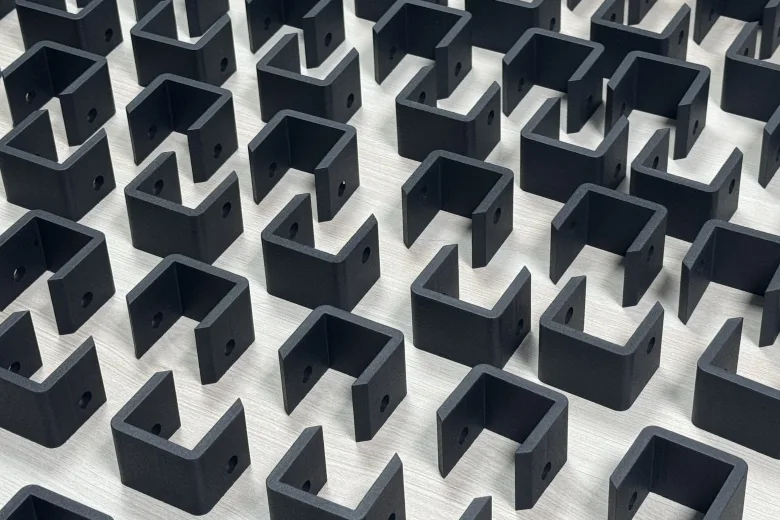
This is the quiet one, and commercially it is the most important on the list. A mould for an injection-moulded part costs thousands and takes weeks. Print the same part and the tooling cost is zero — so a single unit costs roughly what the thousandth unit costs.
That is what makes rapid prototyping and low-volume production viable at all. Below a few thousand units, moulds are not the cheaper option — they are a large upfront bet on a design you have not finished testing.
5. Highly Detailed Architectural Models
A masterplan model with individually detailed towers, correct façade rhythm and a site contour that matches survey data would take a traditional model shop weeks of hand fabrication. Printed from the architect's own CAD, it is dimensionally exact by construction rather than by craftsmanship.
It also survives revisions: when the design changes, you reprint the affected buildings instead of rebuilding the model. This is core work for us — see model making and the 1:60 developer model case study.
6. Custom-Fit Prosthetics and Orthotics
Because a printed part costs the same whether it is unique or identical to the last one, "made for one person's anatomy" stops being a luxury. A limb is 3D scanned, the socket is modelled to that scan, and the fit is right the first time rather than after several manual adjustments.
Our honest position: we print anatomical and fitting models, and prototypes for device developers. We are not a certified medical device manufacturer and do not produce patient-contact or implantable parts — those must be made under the applicable medical device regulations. See medical models for exactly where that line falls.
7. Sculpture and Art That Cannot Be Carved
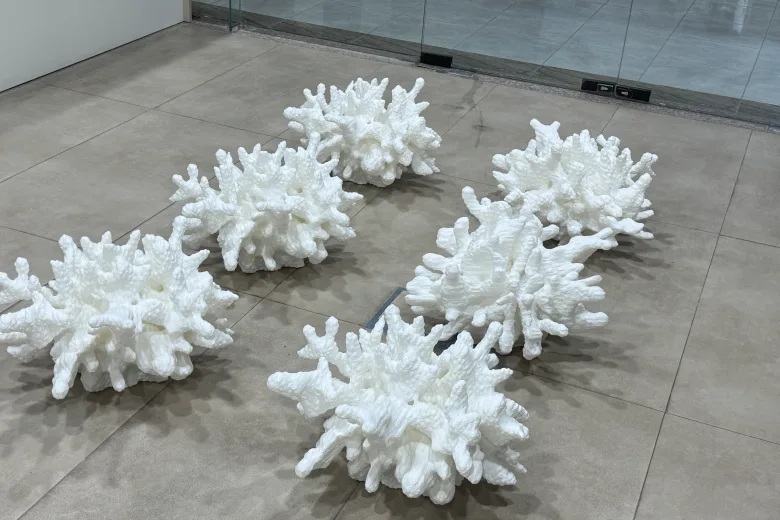
Suspended elements, impossible overhangs, forms that interpenetrate — sculpture that no chisel can reach into and no mould can release. Artists have taken to printing precisely because the constraint that shaped centuries of sculpture simply is not there any more.
Dubai has a genuine appetite for this: printed installations now appear regularly in galleries, retail interiors and exhibition builds. That is the work behind our art and interiors page.
8. Personalised Fashion and Jewellery
Rings, cuffs, eyewear frames and footwear built around one person's measurements. In jewellery the printed part is often not the final piece at all — a fine resin print becomes the pattern for investment casting, which is how intricate designs reach precious metal. More on that on our jewellery page.
9. Printed Food
Food printers extrude chocolate, purées, doughs and pastes into geometries a pastry chef cannot pipe by hand. Some Dubai restaurants have experimented with it for plated desserts and decorative work.
We do not do this. It requires food-grade printers and a food-production environment, which is a different business from ours. It is on this list because it is genuinely interesting, not because you can order it from us.
10. Bio-Printing and Nano-Scale Structures
At the research frontier, laboratories print with living cells — tissue scaffolds, skin grafts for burn research, vascular structures. Separately, two-photon polymerisation prints features smaller than a red blood cell for microfluidics and sensors.
Also not a service we offer, and worth stating clearly: printed transplantable organs are not available today. Working tissue models are real; a printed heart you can implant is not. Any supplier who tells you otherwise is selling something.
What This Means If You Have a Part to Make
Strip out the laboratory items and a practical rule remains: if your part has internal complexity, needs to be one of a kind, or has to move without assembly, printing is not just cheaper — it may be the only way to make it. If it is a simple solid shape in high volume, moulding still wins.
Not sure which side your project falls on? Send the file and an engineer will tell you honestly — including when the answer is "this should be machined".