Editorial note — read this first. This is an industry news story about a product built by someone else. Orbit3D did not design, print, supply, finish or ship any part of the myTMJ Pen, and Noam Aizenberg is not an Orbit3D client. Nothing here is medical advice; we are a manufacturing company, not a healthcare provider. Every factual claim below is sourced to Arduino's published write-up or the public Indiegogo campaign.
Most hardware ideas die at the same place: the quote for injection-mould tooling. Somewhere between the first sketch and the first sellable unit, a founder is told the entry ticket is tens of thousands of dollars and a three-month lead time — and the idea quietly stops.
The myTMJ Pen is a documented case of someone refusing that trade. It is worth understanding in detail, because the method transfers directly to anyone prototyping a physical product from the UAE.
The Problem: Jaw Pain With No At-Home Tool
The temporomandibular joint is the hinge connecting your jaw to your skull. When it misbehaves it produces pain, muscle tightness, clicking, and in bad cases a jaw that locks. TMJ disorders are common enough that most people know someone affected, yet the standard advice — apply heat, massage the muscle — had no single consumer device that did both.
Noam Aizenberg, a mechanical engineer, had lived with the condition for years and kept receiving that same advice with nothing to act on it. The gap between "here is what would help" and "here is a product that does it" was the entire business case.
From Sketch to Working Device in Under a Year
He began designing in September 2023: CAD models of a pen-shaped device that would apply gentle heat and vibration directly to the jaw muscles. The brief he set himself was specific and, importantly, physical:
- Small enough to hold comfortably against the face for several minutes
- USB-C rechargeable
- Safe for skin contact at the working temperature
- Heat and vibration delivered at the same time
Internally that meant an aluminium heating tip, a vibration motor, and a custom circuit board. Arduino's write-up confirms the production board runs a Microchip ATmega48 microcontroller, programmed through the Arduino IDE — an off-the-shelf toolchain doing the job a bespoke embedded contract would normally require.
Why Desktop 3D Printing Was the Whole Strategy
Here is the part that matters to anyone building a handheld product. Ergonomics cannot be reviewed in CAD. Whether a device sits well in the hand, whether the button falls under the thumb, whether the tip reaches the right muscle without straining the wrist — those questions only have answers once something physical exists.
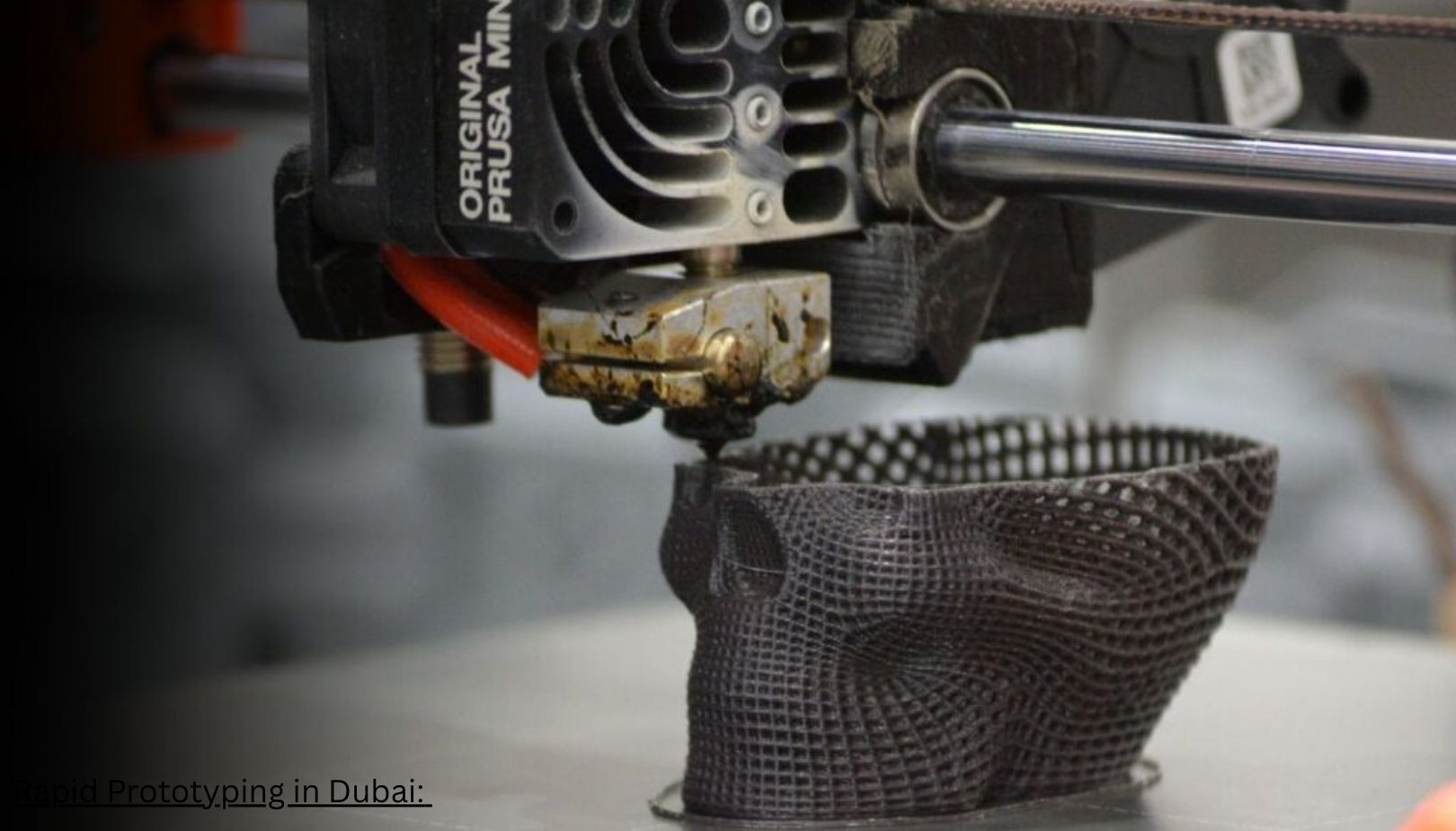
So the housing was printed on desktop FDM and resin machines, overnight, again and again. A new geometry could be designed in the evening and judged in the hand the next morning. Where a moulded workflow gives you perhaps three or four design revisions before the budget runs out, this gives you dozens — and each one is a real answer instead of an opinion.
That loop is not exotic. It is the same rapid prototyping cycle we run for clients in Dubai, and the reason we tell founders to expect several rounds rather than one perfect print.
3D Printing as Production, Not Just Prototyping
By early 2024 the device worked. The conventional next step is to abandon printing and commit to tooling. He didn't.
Units of the myTMJ Pen were 3D printed and assembled in-house in the United States. When demand rose, the answer was more printers rather than a factory — and a design change stayed a same-day file edit rather than a re-tooling negotiation.
This is the genuinely instructive part. Additive manufacturing has quietly become viable for end-use parts at low and medium volumes, which is exactly the range most new products live in. It is the same reasoning behind our own low-volume production work: below a certain quantity, moulds are not cheaper — they are simply a larger upfront bet on a design you have not finished learning about.
Building in Public — and Funding It That Way
The development was documented openly on Instagram and YouTube: sketches, failed prints, firmware problems, assembly. By the time the Indiegogo campaign opened on 5 September 2024, there was an audience that had watched the thing being built.
The campaign closed on 5 October 2024 having raised $12,711 against a $6,000 goal — 212% funded. Modest money by venture standards. Enough money to order PCBs, complete compliance testing and pay for a first production batch, which is all it needed to be.
No investor round. No factory. A printer, a public build log, and a problem the founder personally understood.
What This Means If You Are Building From the UAE
Strip out the specifics and the pattern is transferable:
- Get the physical version early and cheaply. The first print exists to be wrong. Budget for iterations, not for one perfect part.
- Match the process to the question. FDM answers fit, size and ergonomics for very little. Resin answers surface finish and fine detail. Powder-bed nylon answers whether a part survives real use. Our technologies guide lays out which does what.
- Do not assume moulds are the graduation. Run the maths on your actual first-year volume before committing to tooling — see the 2026 cost guide for real Dubai numbers.
- Document the build. The audience that funded this product was earned during development, not after launch.
Where Orbit3D Actually Fits — Said Plainly
We print the physical side of product development: concept and ergonomic prototypes, functional test parts, housings and enclosures, jigs and fixtures, and low-volume production runs in FDM, SLA and HP Multi Jet Fusion nylon. If you are at the stage Noam was at in late 2023, that is work we do every week — upload a file and a quote usually lands the same working day.
What we do not do, and will say so before you ask: we are not a medical device manufacturer. We hold no medical device certification, we do not produce patient-contact or implantable parts, and we cannot take responsibility for regulatory clearance. A device that touches a patient must be produced under the applicable medical device regulations by a certified manufacturer — in the UAE that means engaging MOHAP and the relevant standards early, not after the prototype works. We will print your prototypes and your housings honestly, and tell you at exactly which point you need a partner we are not.
That distinction is the reason this article exists in its current form at all.